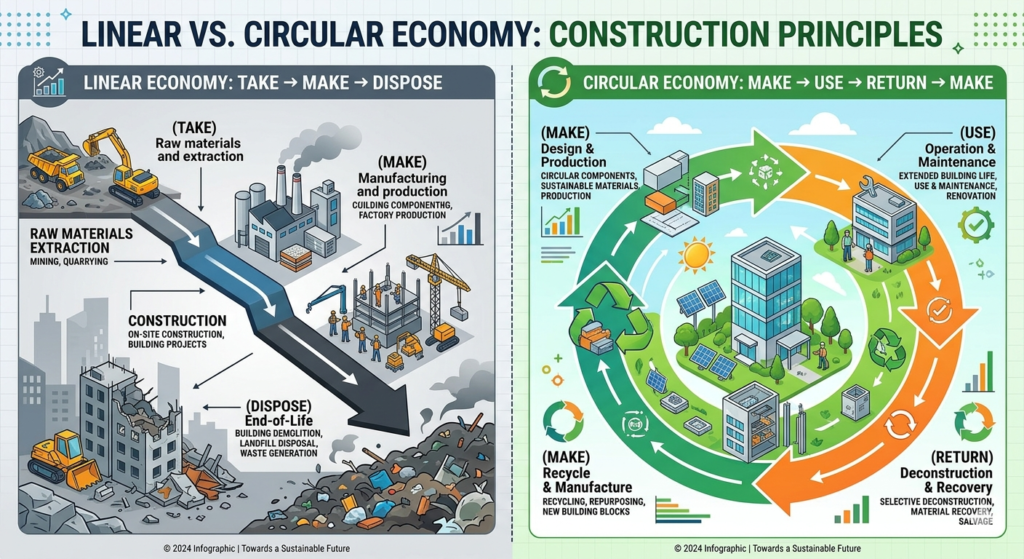
The global construction industry is responsible for a staggering amount of waste. Traditionally, renovating a home involves a linear process: raw materials are extracted, turned into products, used for a few decades, and then violently demolished and sent to a landfill. This “take, make, dispose” model is environmentally destructive and financially inefficient.
However, a radical shift is changing how architects, builders, and homeowners approach renovations. By viewing a house not as a disposable product, but as a temporary bank of valuable materials, we can drastically reduce our environmental impact. This philosophy is the foundation of a zero-waste renovation, ensuring that the resources we use today are preserved for the generations of tomorrow.
What is Circular Construction?
What is circular construction? Circular construction is an approach to building that eliminates waste by prioritizing continuous material reuse. Unlike the traditional linear economy, it employs a closed-loop system where every component is salvaged, repurposed, or recycled, ensuring zero waste goes to landfills at the end of a building’s life.
The goal of circular economy housing is to decouple building activities from the consumption of finite resources. Instead of buying everything brand new and throwing away the old, a circular approach treats an existing home like a materials quarry.
Before a single sledgehammer swings, a circular renovator asks: What can be saved? What can be repurposed? How can these existing materials be integrated into the new design? This mindset turns demolition sites into salvage operations, fundamentally changing the economics of home improvement.
The Principles of Cradle to Cradle Design
To truly master zero-waste building, one must understand the concept of cradle to cradle design. Coined by architects and chemists, this framework argues that materials should never reach a “grave” (the landfill). Instead, they should continuously cycle through the economy as either biological or technical nutrients.
- Biological Nutrients: These are natural materials like untreated timber, hemp insulation, or clay plaster. At the end of their usefulness, they can safely decompose and return to the earth as compost, feeding the next cycle of life.
- Technical Nutrients: These are manufactured materials like steel beams, glass, or certain plastics. They cannot decompose, so they must be designed to be infinitely melted down or remanufactured without losing quality.
When planning your renovation, prioritizing materials that fit into these two distinct categories ensures that your home will never contribute to future toxic waste. For a deeper dive into how this philosophy is altering modern architecture, “Building for a Changing Culture/Climate” (book) provides an excellent exploration of sustainable material lifecycles and human impact.
Prioritizing Material Reuse on Site
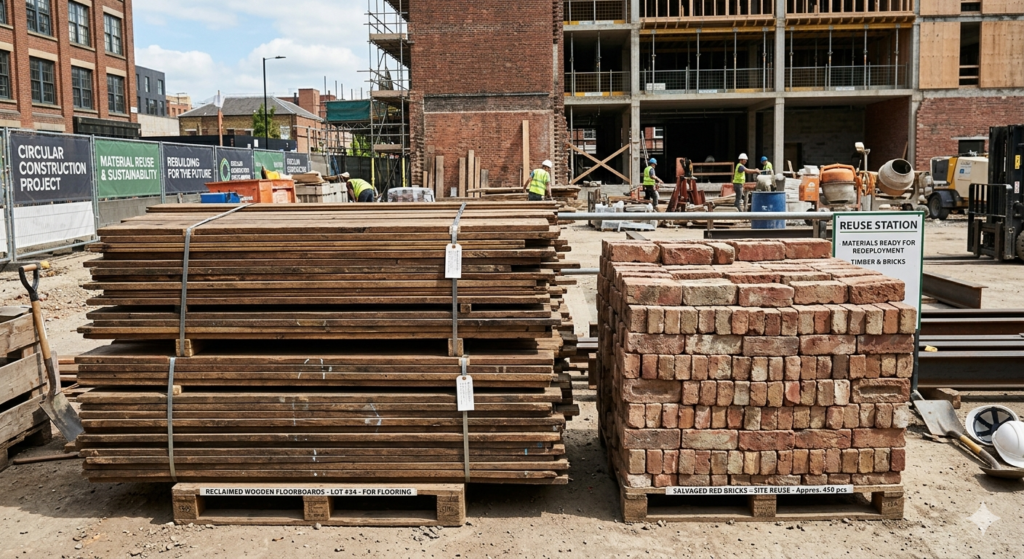
The most effective way to lower a project’s carbon footprint is through direct material reuse. Recycling is good, but it still requires massive amounts of energy to melt and remanufacture a product. Reusing a product in its current physical form requires almost zero energy.
Instead of demolition, a zero-waste project relies on “deconstruction.” This means carefully taking a room apart in the reverse order it was built.
- Old kitchen cabinets can be unscrewed and reinstalled in the garage for tool storage.
- Solid wood floorboards can be gently pried up, planed down, and re-laid.
- Interior doors can be sanded, repainted, and fitted with new hardware.
By finding creative ways to utilize the materials already on site, you save money on disposal fees (like renting a dumpster) and drastically reduce your materials budget.
Implementing a Closed Loop Building Strategy
A true closed loop building strategy looks forward as well as backward. It is not enough to simply reuse old materials today; you must also ensure that the materials you install now can be easily salvaged in fifty years.
This is known as “Design for Disassembly” (DfD). When putting a home together, circular builders avoid chemical adhesives, toxic spray foams, and permanent sealants. If you glue wood floorboards directly to a concrete slab, they will be destroyed when they are eventually removed. If you use screws or a floating floor system, those boards can be easily lifted and reused by the next generation.
As explored throughout this guide, the choices you make during installation dictate the future lifecycle of your home. By utilizing mechanical fasteners and prioritizing natural, separable layers, you ensure your property remains a valuable resource bank indefinitely.
Conclusion
Embracing circular construction represents a profound shift from consumption to stewardship. By committing to a zero-waste renovation, homeowners can significantly reduce the massive environmental burden of traditional construction. Through rigorous material reuse, adopting a cradle to cradle material philosophy, and building for future disassembly, we can create beautiful, high-performing homes that do not cost the earth. Ultimately, the transition to circular economy housing proves that the most sustainable materials are often the ones already sitting right in front of us.
Frequently Asked Questions (FAQ)
1. Is a zero-waste circular renovation more expensive?
It depends on how you value labor versus materials. Circular construction often saves a massive amount of money on purchasing new materials and paying for dumpster disposal. However, careful deconstruction (taking a house apart by hand instead of using a sledgehammer) requires more hourly labor. Overall, costs are often comparable, but the environmental savings are monumental.
2. What are the hardest materials to reuse or recycle in a home?
Composite materials are the enemy of the circular economy. Products made by gluing different materials together—like MDF (Medium Density Fiberboard), plastic-coated flooring, or drywall covered in toxic paint—are incredibly difficult to separate and recycle. They almost always end up in a landfill.
3. What is the difference between recycling and circular construction?
Recycling is an “end-of-pipe” solution that attempts to do something with waste after it has been created, often resulting in “downcycling” (turning a high-quality product into a lower-quality one). Circular construction designs waste out of the system entirely from the very beginning, ensuring materials are maintained at their highest value continuously.
4. How can I practice Design for Disassembly in a basic DIY project?
The simplest rule is to avoid glue. Use screws, bolts, or nails to assemble your projects. For instance, if you are building a stud wall, use screws instead of construction adhesive so the timber can be easily dismantled later without splitting the wood.