One of the most persistent myths in sustainable home improvement is that renewable heating is only for brand-new, airtight buildings. Homeowners living in Victorian terraces, mid-century ranches, or drafty farmhouses often assume they are stuck with fossil fuel boilers forever. However, the technology has evolved rapidly, making installing heat pumps in existing homes a realistic and highly beneficial upgrade.
The truth is that a heat pump can heat absolutely any building, regardless of its age or condition. The real question is not if it will work, but rather how much it will cost to run and what modifications your home will need to make it efficient. Before you dismiss the idea of decarbonizing your historic property, it is crucial to understand the building physics and mechanical realities involved.
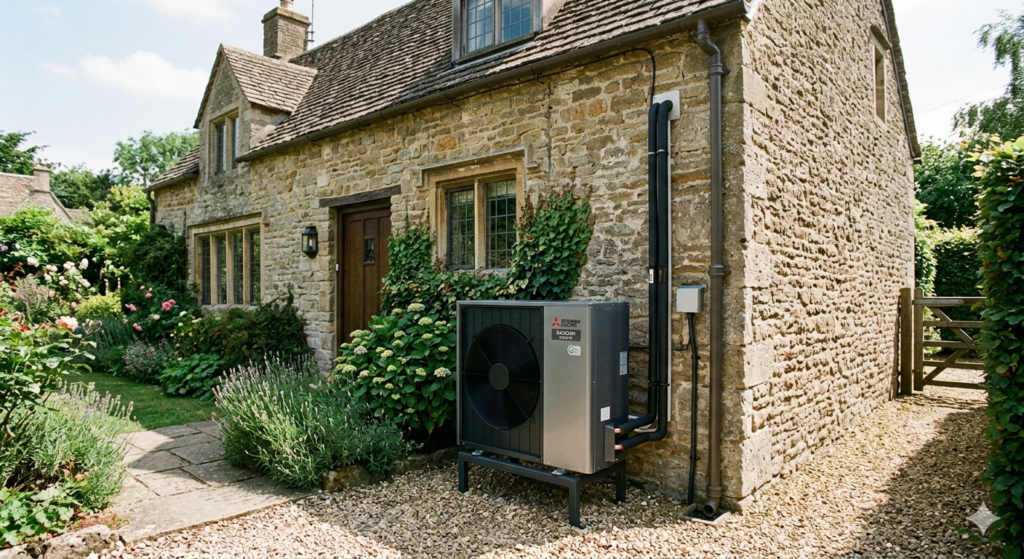
The Big Question: Do Heat Pumps Work in Old Homes?
Yes, installing heat pumps in existing homes is entirely possible and highly effective. While older buildings experience higher heat loss, modern high temperature heat pumps and strategic insulation upgrades allow almost any historic property to successfully transition away from fossil fuels while maintaining comfortable indoor temperatures.
The challenge with older homes is not the heat pump technology itself, but the rate at which the house leaks thermal energy. Traditional gas or oil boilers mask the problem of a drafty house by blasting an overwhelming amount of high-heat energy into the rooms. Heat pumps, on the other hand, operate on a philosophy of “low and slow,” requiring a slightly different approach to system design.
Understanding Flow Temperature and Heat Loss
To understand an air source heat pump retrofit, you must first understand flow temperature. This refers to the temperature of the water traveling from your heating unit to your radiators.
A traditional gas boiler sends water to your radiators at a scalding 160°F to 170°F (70°C to 80°C). Standard heat pumps operate most efficiently when producing water between 95°F and 120°F (35°C to 50°C). Because the water inside the radiator is cooler, it releases less heat into the room per hour.
If your old house is poorly insulated, the room might lose heat through the walls and windows faster than the cooler radiator can replace it. This is why people mistakenly believe heat pumps “do not work” in old houses. They work perfectly; the house simply loses the heat too fast.
The Role of Radiator Sizing
Because a standard heat pump provides cooler water, the surface area emitting that heat must be increased to achieve the same room temperature. This brings us to the crucial step of radiator sizing.
During a retrofit, heating engineers will calculate the exact heat loss of every room. They will often recommend replacing older, single-panel radiators with larger, double or triple-panel versions (known as K2 or K3 radiators). These upgraded units hold more water and have more metal fins, allowing them to output sufficient warmth even at lower flow temperatures.
You do not always have to replace every radiator. Sometimes, improving the efficiency of your current setup is enough. Simple additions, such as installing radiator foil or booster fans behind or under existing units, can significantly increase the amount of warm air pushed into the room, reducing the need for costly replacements.
High Temperature Heat Pumps: A Silver Bullet?
If upgrading radiators or adding insulation is structurally difficult or prohibited by heritage conservation rules, there is another solution. High temperature heat pumps are specifically designed for older, hard-to-treat properties.
These specialized units use advanced refrigerants capable of producing flow temperatures up to 160°F (70°C), perfectly mimicking a traditional boiler. This means you can often keep your existing micro-bore pipework and cast-iron radiators exactly as they are.
However, there is a trade-off. Generating higher temperatures requires the compressor to work harder, which consumes more electricity. While they will successfully heat an old home, their operational efficiency (Coefficient of Performance) will be lower than a standard heat pump running at low temperatures. This is an important consideration outlined in our broader Decarbonization Guide.
The Reality Check: Fabric First
The ultimate reality check for any homeowner considering a retrofit is the “Fabric First” principle. You can install a large heat pump in an uninsulated, drafty Victorian home, and it will keep you warm. However, the unit will be physically massive, expensive to purchase, and costly to run.
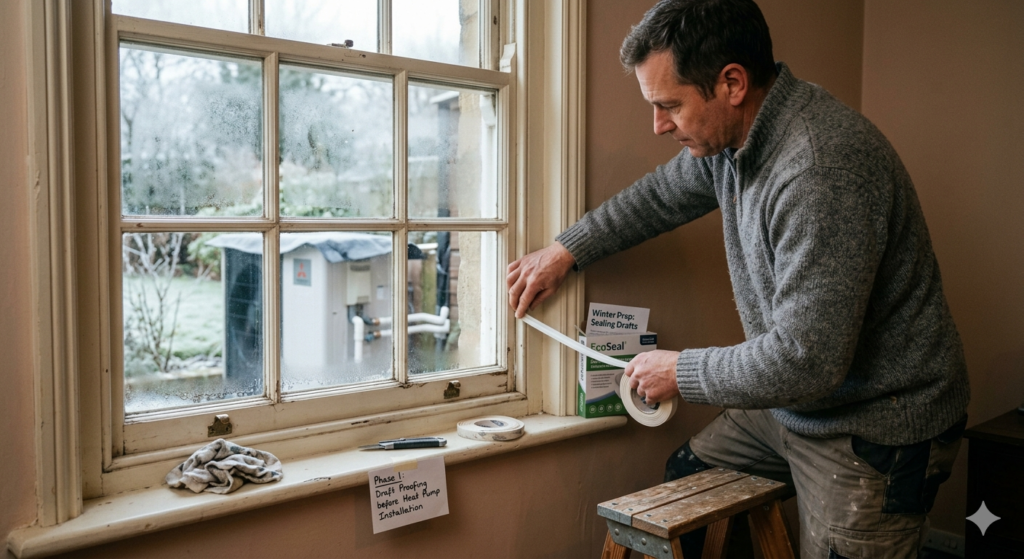
The smartest financial move is always to reduce the home’s heat loss first. Adding loft insulation, sealing drafty floorboards, and upgrading to heavy thermal curtains can drastically lower your heating demand.
By improving the building envelope, you allow the heating engineer to specify a smaller, cheaper heat pump. A smaller unit operating at lower temperatures will reward you with significantly lower energy bills, proving that historic charm and modern efficiency can successfully coexist.
Conclusion
The persistent myth that older properties are incompatible with renewable energy is fundamentally false. Installing heat pumps in existing homes requires careful planning, accurate heat loss calculations, and sometimes a shift in how we understand domestic heating. Whether you opt for a standard unit with upgraded radiators or choose the convenience of high temperature heat pumps, decarbonizing your historic property is entirely achievable. By addressing drafts and insulation first, you ensure that your new system operates at peak efficiency, bringing your classic home comfortably into the 21st century.
Frequently Asked Questions (FAQ)
1. Do I need to change all the pipework in my old house for a heat pump?
Not always. A professional heating engineer will assess your existing pipework. While older “micro-bore” pipes (very narrow pipes) can sometimes restrict the flow rate required by standard heat pumps, many systems can be adapted without tearing up floorboards. High-temperature heat pumps are specifically designed to work with existing pipework.
2. Are air source heat pumps noisy?
Modern heat pumps are surprisingly quiet. They typically generate between 40 and 60 decibels of sound, which is comparable to the hum of a modern refrigerator or a light conversation. When placed strategically away from bedroom windows, you will likely never notice the noise from inside the house.
3. Will a heat pump ruin the look of my historic home?
The outdoor compressor unit does require space, but it does not have to be an eyesore. Units can be hidden behind acoustic fencing, slatted wooden enclosures, or landscaping. For listed buildings, you may need planning permission to ensure the placement does not detract from the heritage facade.
4. Can I keep my gas boiler as a backup?
Yes. This setup is known as a “hybrid heat pump system.” The heat pump handles 80-90% of the heating during mild and cold weather. If the temperature drops to extreme, freezing lows, the system automatically switches to the gas boiler. This is a popular stepping stone for homeowners cautious about full electrification.