As homeowners increasingly insulate their walls and seal up drafty windows to save energy, a new challenge arises. While eliminating drafts is excellent for retaining winter heat, it creates a sealed plastic box that traps everything generated inside. Cooking odors, shower humidity, carbon dioxide from breathing, and chemical off-gassing from furniture suddenly have no way to escape.
Opening a window solves the air quality problem but completely ruins the energy efficiency you just paid for, letting your expensive heating fly out into the winter sky. To resolve this paradox, modern building physics relies on a highly specialized piece of technology. Understanding how to breathe safely and comfortably in a sealed, energy-efficient building requires looking at the “lungs” of the modern home.
The Core Definition
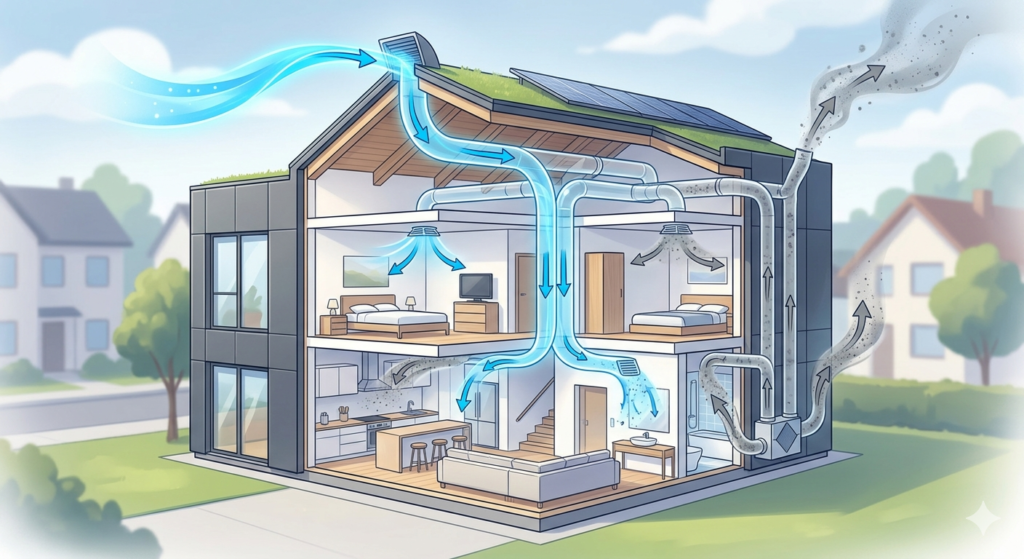
What is mechanical ventilation with heat recovery? Mechanical Ventilation with Heat Recovery (MVHR) is a continuous fresh air system that extracts stale, moist air from a building while simultaneously supplying filtered outdoor air. Crucially, it uses a heat exchanger to transfer the warmth of the outgoing air to the incoming cold air.
By transferring the thermal energy between the two air streams, an MVHR unit ensures that your home receives a constant supply of fresh oxygen without the severe heat loss associated with traditional ventilation. It bridges the gap between airtight insulation and human health.
Why Airtightness Ventilation is Mandatory
In the building science community, there is a golden rule: “Build tight, ventilate right.” If you undergo a deep energy retrofit and systematically seal all the invisible gaps in your building envelope, relying on natural ventilation (accidental drafts) is no longer an option.
Without dedicated airtightness ventilation, a sealed home quickly develops high humidity, leading to condensation on windows and structural mold. Furthermore, the air quickly becomes stale. Using a CO2 monitor or air quality monitor in an unventilated, airtight bedroom overnight will visually demonstrate how rapidly carbon dioxide levels spike, often causing occupants to wake up feeling groggy or suffering from headaches.
Implementing a mechanical solution is not just an optional luxury; it is a vital safety requirement for high-performance buildings and a cornerstone concept detailed in our Decarbonization Guide.
How Heat Recovery Ventilation Works
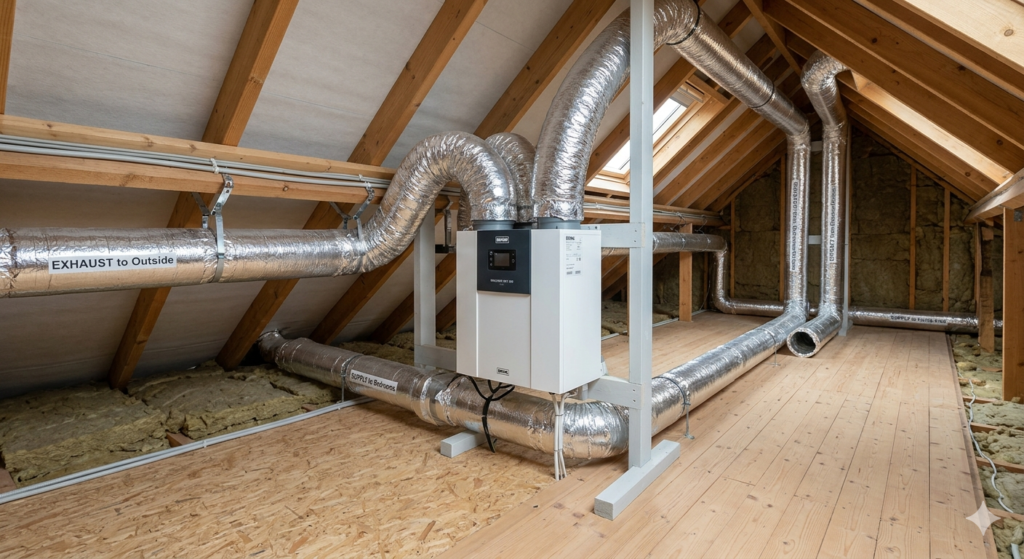
The mechanics behind heat recovery ventilation are brilliantly simple but highly effective. An MVHR system operates using a central unit connected to a network of hidden ducts running throughout the house.
The system manages two entirely separate air streams:
- Extraction: It continuously pulls warm, damp, and stale air from “wet” rooms, such as kitchens, bathrooms, and utility rooms.
- Supply: Simultaneously, it draws in freezing cold, fresh air from outside and delivers it to “habitable” rooms, like bedrooms, living rooms, and offices.
These two streams of air meet inside the MVHR unit’s central “heat exchanger core.” They pass through hundreds of alternating, microscopic plastic or aluminum channels. The physical air streams never actually touch or mix—meaning bathroom odors never enter your bedroom. However, the heat from the extracted bathroom air conducts through the thin channel walls, pre-warming the freezing outdoor air before it enters your living space.
The Impact on Indoor Air Quality
While the energy savings from recovering 80% to 90% of your heat are substantial, the most immediate benefit of a fresh air system is the profound improvement in indoor air quality.
Modern MVHR units are equipped with high-grade filters (often F7 or HEPA standard) on the intake duct. Before the outdoor air ever reaches your bedroom, it is stripped of pollen, dust, diesel particulates, and other urban pollutants. For asthma and allergy sufferers, this transforms the home into a true sanctuary.
Internally, the constant extraction process ensures that volatile organic compounds (VOCs) from cleaning products, pet dander, and excessive shower moisture are swept out of the house 24 hours a day, 365 days a year.
Conclusion
Transitioning to a highly efficient, decarbonized home requires a fundamental shift in how we manage air. Mechanical Ventilation with Heat Recovery (MVHR) is the definitive solution to the airtightness dilemma. By acting as the mechanical lungs of the building, it effortlessly balances the need for rigorous energy conservation with the biological necessity for clean, fresh oxygen. Whether you are aiming for the rigorous Passive House standard or simply want to eliminate condensation and improve your family’s indoor air quality, installing a heat recovery ventilation system is an indispensable investment in your home’s future.
Frequently Asked Questions (FAQ)
1. Can I install an MVHR system in an old, drafty house?
You can, but it is highly inefficient and generally not recommended. If a house is extremely leaky, the wind will simply blow cold air through the gaps in the walls, bypassing the heat exchanger entirely. MVHR systems only become financially and functionally viable when the home has achieved a reasonable level of airtightness (typically an ACH50 score of 3.0 or lower).
2. Does an MVHR system replace my heating or air conditioning?
No. An MVHR system does not generate heat or actively cool the air (like an AC compressor). It only recovers the thermal energy that is already inside the house. You still need a primary heating system (like a heat pump) to generate the initial warmth.
3. Are MVHR systems noisy?
A properly designed, sized, and commissioned MVHR system should be virtually silent. If you can hear a loud rushing or humming noise from the ceiling vents, it usually indicates that the ductwork is too narrow, the fan is undersized and overworking, or the system lacks appropriate acoustic silencers.
4. How much maintenance does an MVHR system require?
The most critical maintenance is changing the air filters, which typically needs to be done every 6 to 12 months depending on outdoor pollution levels. Additionally, the heat exchanger core should be gently cleaned or vacuumed every few years, and the external intake grilles should be kept clear of leaves and debris.