Every winter, millions of homeowners crank up their thermostats to fight off the cold, only to watch their energy bills skyrocket. The culprit is rarely a broken furnace or a malfunctioning radiator. Instead, the problem lies in the invisible boundary between the cozy interior of your home and the harsh weather outside. Understanding the thermal envelope is the most critical step in creating a comfortable, energy-efficient living space.
It is the fundamental science of keeping heat in during the winter, keeping it out during the summer, and managing moisture year-round. Before you invest in expensive solar panels or a new heating system, you must first secure the shell of your house. By mastering the concepts of insulation and airtightness, you can permanently reduce your energy demand and vastly improve your indoor comfort.
What is a Thermal Envelope?
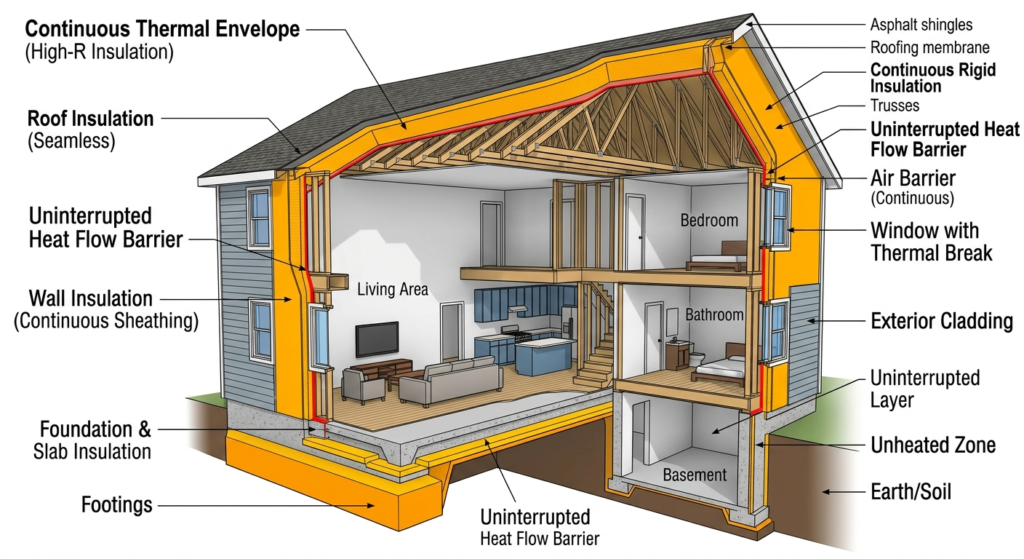
Understanding the thermal envelope means recognizing it as the physical separator between the conditioned and unconditioned environment of a building. It consists of the roof, walls, windows, doors, and foundation, which work together to control heat transfer, air leakage, and moisture movement.
When architects and engineers talk about the building envelope, they are referring to this entire exterior shell. If there is a break, gap, or weak point in this shell, your home’s mechanical systems have to work overtime to compensate for the continuous heat loss. A high-performance envelope acts as a thermos, keeping the internal temperature stable regardless of the extreme conditions outside.
The Physics of Heat Loss
To master your home’s performance, you must first understand how heat moves. The basic law of thermodynamics dictates that heat always flows from a warm area to a cold area. In winter, the heat from your radiators actively tries to escape outside. In summer, the blazing sun tries to push heat into your air-conditioned living room.
Heat escapes a building in three primary ways:
- Conduction: Heat traveling directly through solid materials, like uninsulated wood framing or single-pane glass.
- Convection: Heat moving via air currents, slipping out through drafts around doors, floorboards, and recessed lighting.
- Radiation: Heat transferring through space, such as the sun’s energy radiating through a window and overheating a room.
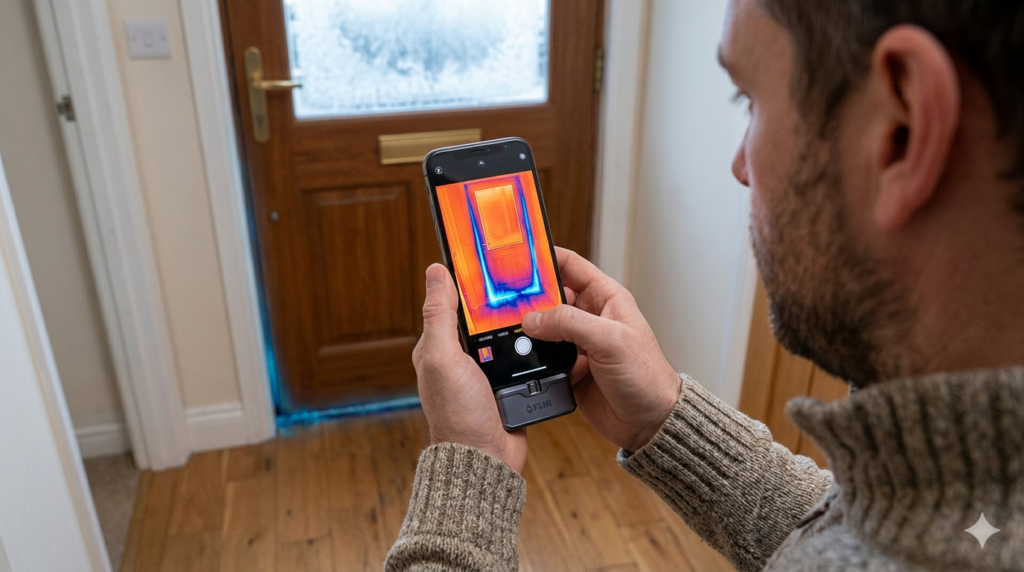
Finding exactly where your home is losing heat can be difficult since these thermal bypasses are entirely invisible to the naked eye. Utilizing a FLIR Thermal Imaging Camera during the colder months allows you to physically see invisible cold spots, identify missing insulation in the walls, and pinpoint drafty door frames right on your smartphone screen.
The Two Pillars of the Building Envelope
Creating an effective boundary against the elements requires two distinct but highly dependent components: insulation and airtightness. One cannot function properly without the other.
Insulation: The Thermal Barrier
Insulation acts as your primary thermal barrier against conduction. Materials like fiberglass, mineral wool, cellulose, or wood fiber are manufactured to be filled with tiny pockets of trapped air. Because still air is a very poor conductor of heat, these materials drastically slow down the rate at which thermal energy travels through your walls and roof.
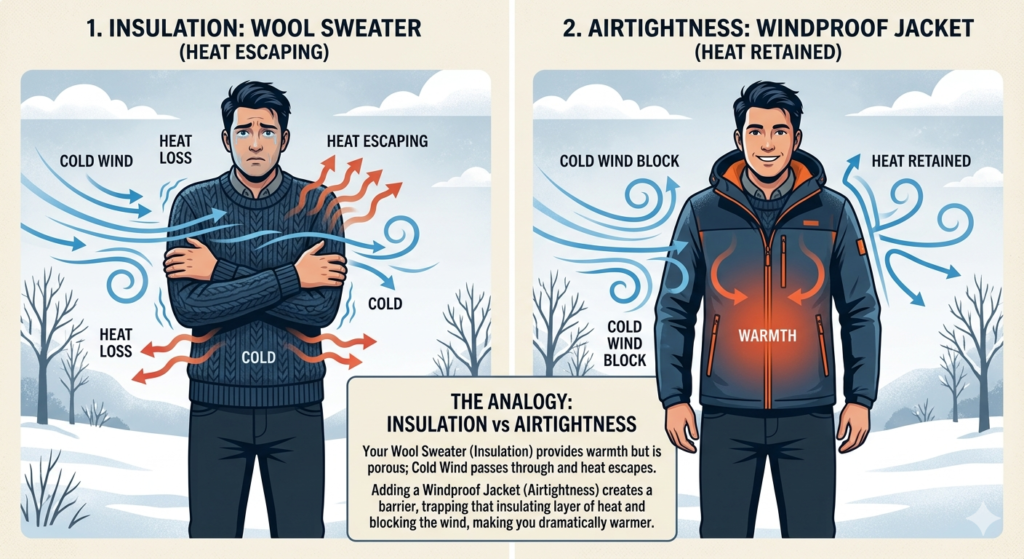
However, insulation is only effective if the air inside it remains completely still. Think of a thick, chunky knit wool sweater: it keeps you very warm on a calm, cold day. But if a freezing wind starts to blow, the cold air slices right through the knit, and you instantly feel the chill.
Airtightness: Stopping the Drafts
This is where airtightness comes in to stop convection. Airtightness involves meticulously sealing every crack, gap, and joint in the building’s shell to prevent uncontrolled air leaks.
Returning to the sweater analogy, airtightness is the windbreaker you wear over the wool sweater. By stopping the wind from blowing through the insulation, the thermal barrier can actually do its job. You cannot simply stuff more insulation into a drafty wall and expect it to perform well; you must stop the air movement first.
Managing Moisture: The Vapor Control Layer
While stopping heat and air is vital, a properly designed thermal envelope must also manage water. Humans generate massive amounts of water vapor indoors daily through cooking, breathing, showering, and drying clothes. If this warm, moist air travels outward into the wall cavity and hits a cold surface (like the back of your exterior brickwork), it will condense into liquid water.
To prevent this hidden structural damage and the resulting mold growth, modern envelopes incorporate a vapor control layer (often called a vapor retarder). This is typically a specialized, airtight membrane installed on the warm side of the insulation (just behind your interior drywall).
The vapor control layer dictates how much moisture can pass into the wall assembly. By carefully calculating the dew point and controlling vapor diffusion, building scientists ensure that the wall assembly remains dry, healthy, and durable throughout the changing seasons.
Conclusion
A high-performing home is not defined by its modern heating system or its sleek solar panels, but by the integrity of its exterior shell. By understanding the thermal envelope, homeowners can make informed, scientific decisions about where to invest their renovation budget for the highest return. Prioritizing a continuous thermal barrier, rigorous airtightness, and a properly detailed vapor control layer is the only way to permanently halt heat loss. Ultimately, mastering your building envelope is the foundational step toward achieving a truly sustainable, comfortable, and resilient home.
Frequently Asked Questions (FAQ)
1. Can a house be too airtight?
A house cannot be too airtight, but it can be under-ventilated. “Build tight, ventilate right” is the golden rule of building physics. When you make a house highly airtight to stop drafts and heat loss, you absolutely must install a mechanical ventilation system (like MVHR) to provide a constant, controlled supply of fresh, filtered air.
2. What is the most important part of the thermal envelope?
Continuity is the most important part. A thermal envelope is only as strong as its weakest link. Having 12 inches of insulation in your attic is severely compromised if your windows are single-glazed or if there is a massive uninsulated gap where the wall meets the roof (a thermal bridge).
3. How do I know if my thermal envelope is failing?
Common signs of a failing building envelope include cold drafts near baseboards and windows, wildly fluctuating indoor temperatures, high heating bills, and condensation forming on the inside of your window glass during the winter.
4. Does replacing my windows improve the thermal envelope?
Yes, upgrading from single or old double-pane windows to modern, thermally broken triple-glazed windows significantly improves the envelope. However, the installation is just as important as the window itself; the gap between the new window frame and the rough wall opening must be meticulously air-sealed and insulated.