In the world of sustainable construction, terminology can get confusing fast. You might hear terms like “green building,” “eco-friendly,” “carbon neutral,” and “high performance” thrown around interchangeably. However, two specific standards stand out as the leaders in the industry: Passive House and Net Zero.
While both aim to reduce the environmental impact of our homes, they approach the problem from different angles. One focuses on rigorous energy efficiency and comfort through building physics, while the other focuses on balancing energy consumption with renewable energy production. Understanding the nuance of passive house vs net zero is crucial for any homeowner planning a major project, as it dictates where you should spend your budget: on insulation or on solar panels?
The Core Difference Explained
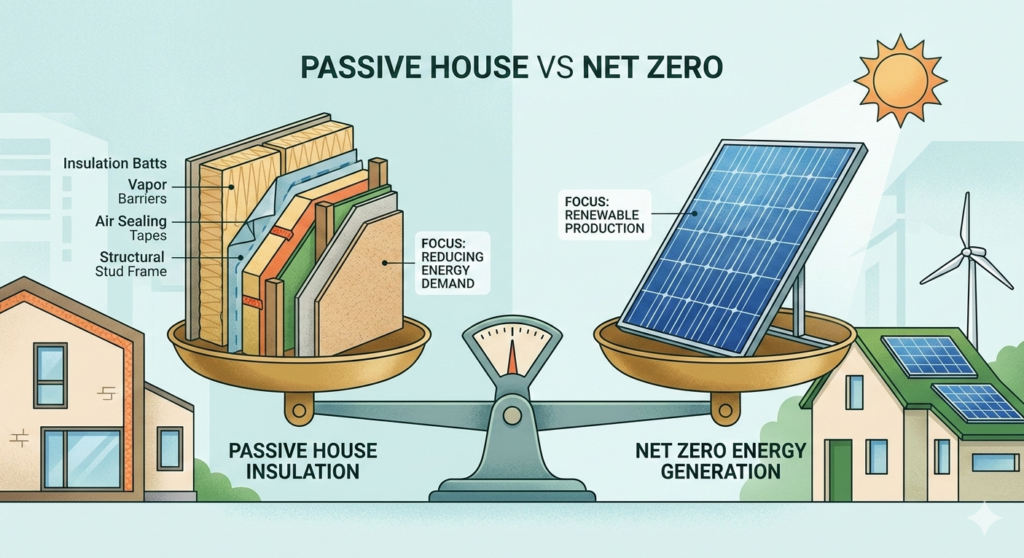
The main difference between Passive House and Net Zero is their primary focus. Passive House is a performance standard that prioritizes reducing a building’s energy demand to the absolute minimum through insulation and airtightness. Net Zero is a balance metric that ensures a building produces as much renewable energy as it consumes over the course of a year.
To put it simply: Passive House is about conservation (saving energy), while Net Zero is about balance (generating what you use).
Passive House: The Comfort Standard
Originating in Germany (Passivhaus), this standard is arguably the most rigorous energy efficiency certification in the world. It relies on five principles:
- Continuous insulation (no thermal bridges).
- Airtight construction.
- High-performance windows (usually triple-glazed).
- Moisture recovery ventilation.
- Optimized solar gain (using the sun to heat the home).
The result is a low energy building that requires very little active heating or cooling. It maintains a constant temperature year-round, offering exceptional comfort.
Net Zero: The Balance Sheet
A zero carbon home or Net Zero Energy building might not necessarily be as strictly insulated as a Passive House. Instead, it focuses on the math: if your home uses 10,000 kWh of electricity a year, you must generate 10,000 kWh of renewable energy (usually via solar PV) to offset it.
Can a Home Be Both?
Absolutely. In fact, combining the two is often the “gold standard” for sustainable housing.
If you are planning a comprehensive renovation—as discussed in our “Deep Energy Retrofit Guide“—aiming for Passive House levels of efficiency first is the smartest financial move. By drastically reducing the energy load of the house, you need far fewer solar panels to reach Net Zero.
Conversely, trying to achieve Net Zero on a drafty, poorly insulated house is difficult and expensive. You would need a massive solar array to offset the waste of a leaky building. This is why building scientists advocate for “Fabric First”: fix the building envelope before buying the power plant.
For those interested in the technical minutiae of how these layers come together, book resources offer an in-depth look at the specific construction assemblies required to hit these high targets.
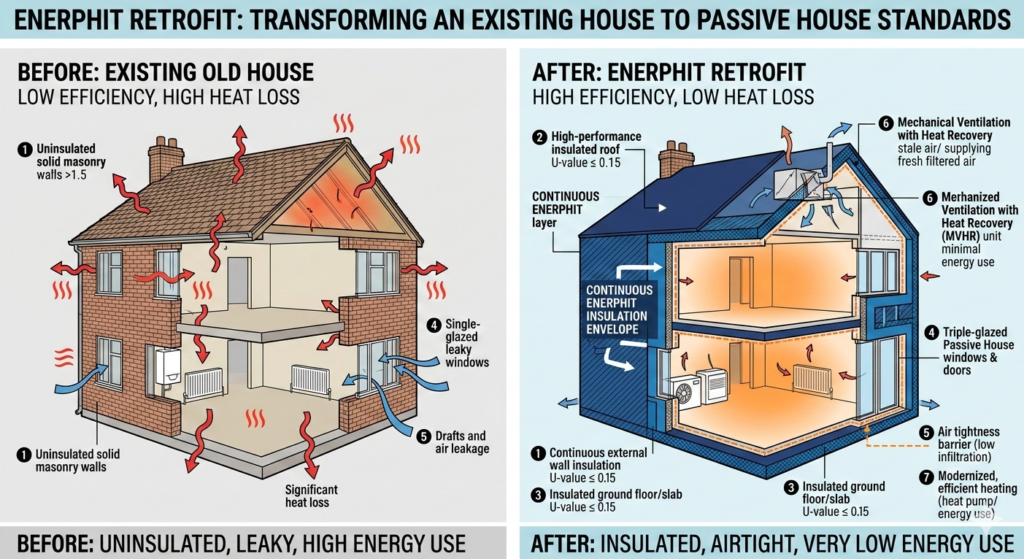
The EnerPHit Standard: Passive House for Retrofits
Achieving the classic Passive House standard in an existing building is incredibly difficult due to thermal bridges (like basement foundations) that cannot be easily fixed. Recognizing this, the Passive House Institute created the EnerPHit standard.
EnerPHit is specifically designed for retrofits. It relaxes the energy demand requirements slightly to account for the constraints of existing architecture, while still demanding the same high quality of components and health benefits. If you are renovating an old Victorian or a 1970s ranch, EnerPHit is likely the certification you should be looking at, rather than the new-build Passive House standard.
Other Contenders: LEED and Green Codes
While Passive House and Net Zero dominate the energy conversation, other certifications like LEED for Homes (Leadership in Energy and Environmental Design) take a broader approach. LEED considers water usage, material sustainability (e.g., bamboo floors), site location, and waste management.
- Passive House: Focuses 90% on energy and comfort.
- Net Zero: Focuses 100% on the energy balance sheet.
- LEED: Focuses on holistic environmental impact (water, materials, site).
Choosing the right one depends on your goals. If your primary pain point is a cold, drafty house with high bills, Passive House/EnerPHit is the solution. If your goal is to market a holistic “eco-mansion,” LEED might carry more weight with real estate agents.
Conclusion
When weighing passive house vs net zero, remember that they are not mutually exclusive. The most sustainable home is one that reduces its demand first (Passive House principles) and then meets that tiny demand with renewables (Net Zero).
For the average homeowner looking to retrofit, chasing a specific certification plaque is less important than applying the physics behind them. Start by reducing your energy waste. A super-insulated, airtight home will always be a better investment than a leaky home covered in solar panels. Whether you aim for the rigorous EnerPHit standard or simply a “low energy” renovation, the path to a future-proof home begins with the building envelope.
Frequently Asked Questions (FAQ)
1. Is Passive House more expensive to build than a standard home?
Generally, yes. Passive House construction can cost 5-10% more upfront due to higher quality windows, more insulation, and specialized labor. However, the operational costs (heating and cooling) are typically 80-90% lower, offering a return on investment over time.
2. Can I open the windows in a Passive House?
Yes, this is a common myth. You can open windows whenever you want. However, because the ventilation system provides constant fresh air and the insulation maintains the temperature, you typically don’t need to open them for fresh air or cooling as often as in a standard home.
3. Does Net Zero mean I am off the grid?
Not necessarily. Most Net Zero homes are “grid-tied.” They export excess solar power to the grid during sunny days and draw power from the grid at night. “Net Zero” means the total creates a balance of zero over a year, not that you are physically disconnected from the utility company.
4. What is the difference between Zero Carbon and Net Zero Energy?
Net Zero Energy deals with kilowatt-hours (electricity/gas). Zero Carbon deals with emissions. For example, if you use a gas boiler, you might be Net Zero Energy (by exporting electricity) but not Zero Carbon (because burning gas releases CO2). As grids become greener, these definitions are merging, but Zero Carbon is generally the more environmentally critical metric.