Transforming a cold, drafty house into a highly efficient, low-carbon home is a monumental task. The sheer scale of the decisions involved—what insulation to buy, which heating system to install, and how to sequence the work—can paralyze even the most enthusiastic homeowner. Before you tear down a single wall or purchase any materials, you must understand how to conduct a home energy audit.
Jumping directly into construction without a plan is the fastest way to waste your renovation budget on the wrong upgrades. The administrative and analytical side of retrofitting is just as critical as the physical labor. By diagnosing exactly where your home is failing and creating a step-by-step financial plan, you can eliminate guesswork and build a resilient, future-proof property.
The Foundation of Your Retrofit Roadmap
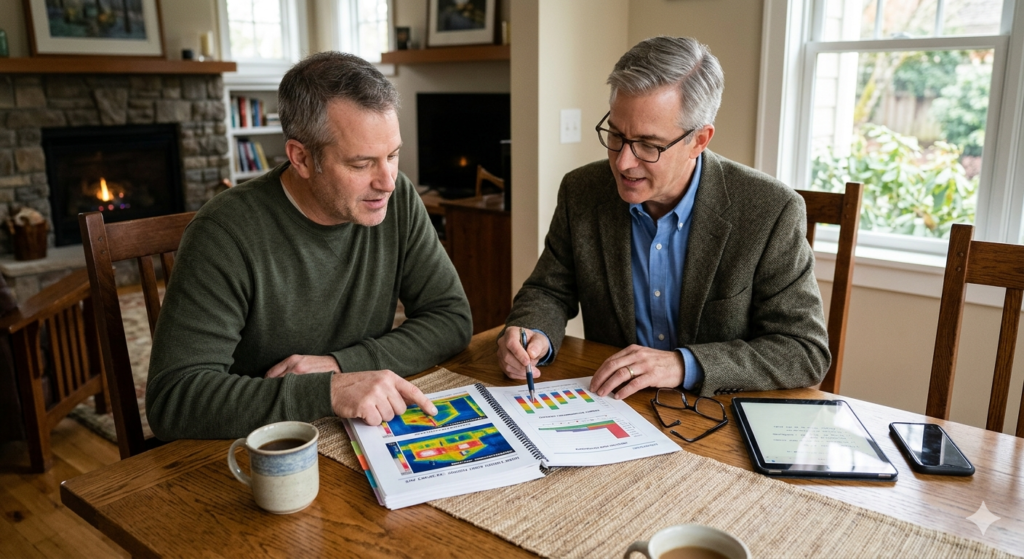
How to conduct a home energy audit? To conduct a home energy audit, you must hire a certified energy assessor to physically analyze your building’s thermal envelope, perform a depressurization test, and complete a thermal imaging survey. This scientific assessment identifies invisible heat leaks, establishing the baseline data required to plan your retrofit roadmap.
A successful deep retrofit relies on accurate data, not assumptions. You might think your windows are the main source of heat loss, but an audit might reveal that an unsealed attic hatch is actually draining the majority of your energy.
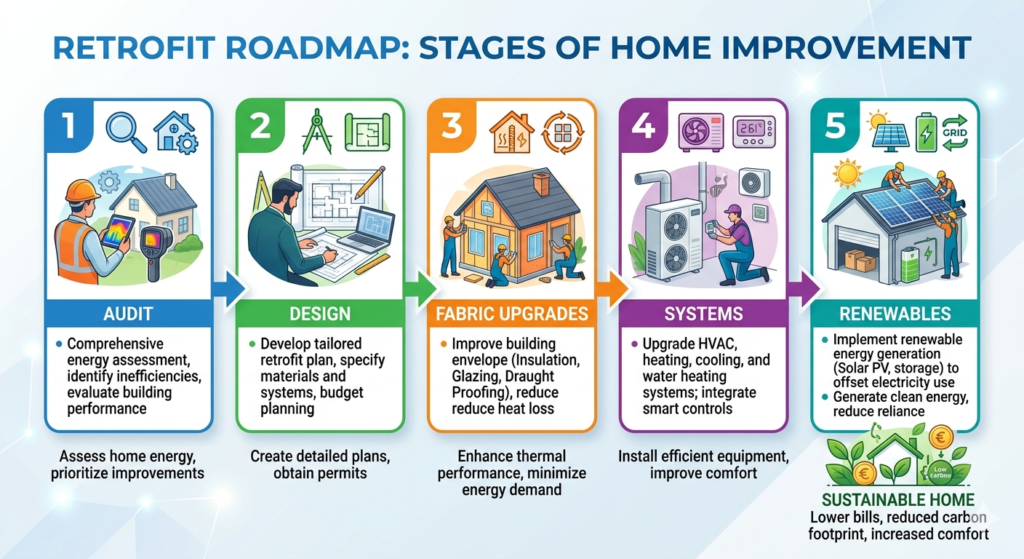
This master plan acts as your Retrofit Roadmap, a living document that dictates the exact sequence of upgrades. By knowing the precise condition of your home’s fabric, you can prioritize the interventions that offer the highest carbon reduction and the best financial return on investment.
Understanding the EPC Rating
In many countries, a property’s energy efficiency is legally summarized by a standardized certificate, such as the EPC rating (Energy Performance Certificate) in the UK and Europe. This rating grades the property on a scale from A (highly efficient) to G (highly inefficient).
While an EPC is a useful starting point for understanding a building’s general performance, it has severe limitations for deep retrofitting. Standard EPC assessments are largely visual and rely on generic assumptions about the age of the property and its basic heating systems.
An EPC assessor typically does not look inside the walls or measure actual air leakage. Therefore, relying solely on an EPC to plan a multi-thousand-dollar renovation is highly risky. To build a true roadmap, you must move beyond the basic certificate and commission a comprehensive, diagnostic audit.
The Science of the Audit: Blower Doors and Thermal Imaging
A professional energy audit involves rigorous on-site testing by a certified energy assessor. The two most critical diagnostic tools they use are the blower door and the infrared camera.
The auditor will install a powerful fan in your exterior door frame to depressurize the house. This forces cold outside air through every unsealed crack and gap in your home’s envelope. This test precisely measures your home’s airtightness (or lack thereof), giving you a metric to improve upon.
Simultaneously, while the house is depressurized, the auditor will conduct a thermal imaging survey. Using an infrared camera, they will scan the interior walls, ceilings, and floors. The camera visualizes the invisible cold air rushing in through the gaps, clearly highlighting hidden thermal bridges, missing insulation in wall cavities, and failing window seals.
Budgeting the Assessment
Many homeowners hesitate to pay for an audit, viewing it as an unnecessary administrative expense. However, this assessment is the ultimate cost-saving tool.
The blower door test cost and the accompanying thermal survey vary depending on the size of your home and your location, but it generally represents a tiny fraction of your total renovation budget. Spending a few hundred dollars to identify exactly where to put your insulation can save you thousands of dollars in misplaced materials and oversized heating systems.
To begin this process, finding a qualified professional is essential. Utilizing a reputable Directory of Energy Auditors (or DIY Kit) can help you locate certified assessors in your area who specialize in deep energy retrofits rather than just basic compliance certificates.
Building the Retrofit Budget
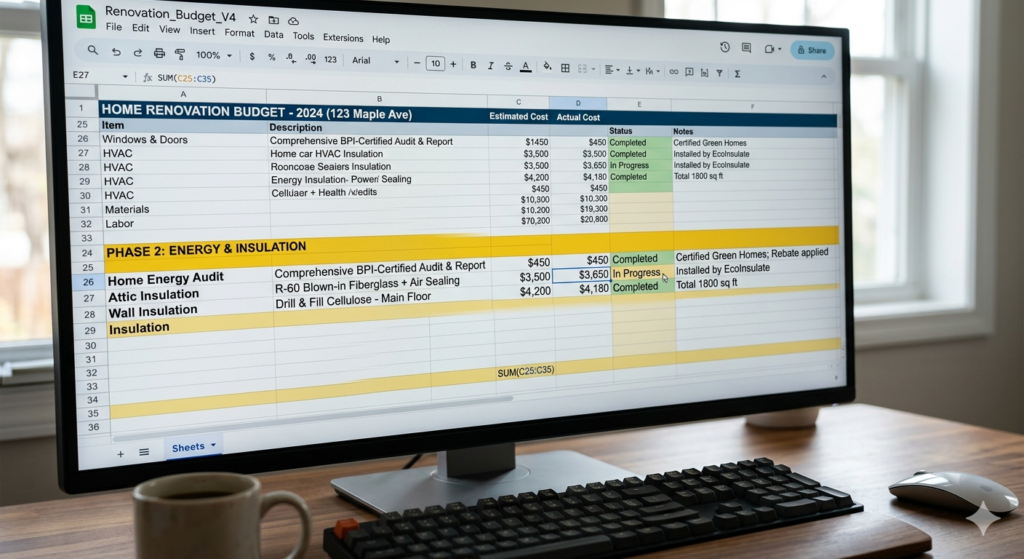
Once the audit is complete, your assessor will provide a detailed report. This report is the key to creating your financial plan.
Instead of looking at the massive total cost of a whole-house retrofit, use the audit data to break the project into affordable, phased chunks.
- Phase 1 (Low Cost): Sealing the drafts identified by the blower door test and adding cheap loft insulation.
- Phase 2 (Medium Cost): Upgrading windows or adding internal wall insulation to the coldest rooms identified in the thermal survey.
- Phase 3 (High Cost): Installing an air source heat pump or solar panels once the fabric is secure.
By linking your budget directly to the empirical data from the audit, you ensure that every dollar you spend delivers measurable improvements in comfort and efficiency.
Conclusion
Embarking on a sustainable home renovation requires treating your property like a scientific system. Understanding exactly how to conduct a home energy audit is the non-negotiable first step in this journey. By looking past basic administrative scores like the EPC rating and investing in rigorous diagnostic tools—such as a thermal imaging survey—you empower yourself with factual data. This targeted approach allows you to build a highly accurate, financially responsible retrofit roadmap, guaranteeing that your investment successfully transforms your home into a beacon of modern energy efficiency.
Frequently Asked Questions (FAQ)
1. How much does a comprehensive home energy audit cost?
The cost varies based on location and the size of the home, but a professional diagnostic audit that includes a blower door test and thermal imaging typically ranges from $300 to $800. This investment often pays for itself by preventing you from buying oversized heating equipment or unnecessary materials.
2. Can I do a home energy audit myself?
You can perform a basic DIY audit by checking for drafts with a smoke pencil, inspecting your attic insulation levels, and swapping out inefficient lightbulbs. However, you cannot accurately measure your home’s airtightness without a mechanical blower door system, making a professional assessment necessary for deep retrofits.
3. When is the best time of year to get a thermal imaging survey?
Thermal imaging is most effective during the colder months (typically late autumn to early spring). The camera relies on a significant temperature difference (usually at least 10°C / 18°F) between the inside of your heated home and the cold outside air to clearly visualize heat loss and missing insulation.
4. How long does a professional energy audit take?
For a standard single-family home, a comprehensive physical audit typically takes between 2 to 4 hours. The assessor will spend this time measuring the exterior, evaluating the mechanical systems, setting up the blower door, and meticulously scanning the interior rooms.