Many homeowners invest heavily in thick, high-quality insulation, expecting immediate reductions in their winter heating bills. Yet, despite adding inches of fluffy material to their attics and walls, their homes remain surprisingly chilly. The missing piece of the puzzle is almost always a lack of air control.
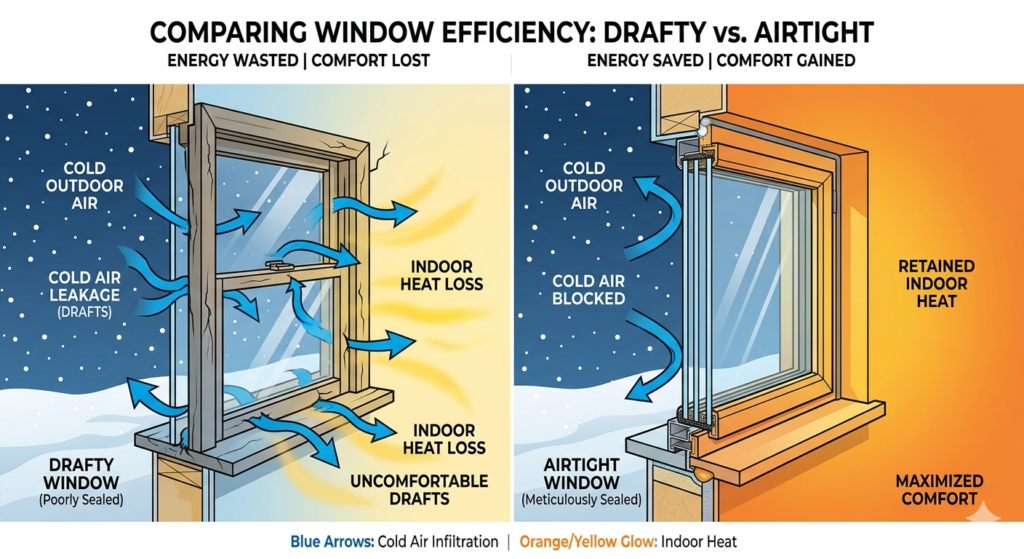
You can have the best insulation in the world, but if the winter wind can blow straight through it, its thermal value plummets. Understanding the importance of airtightness in homes is the critical step that separates a mediocre renovation from a high-performance, energy-efficient sanctuary. By learning how to stop uncontrolled drafts, you can lock in your expensive heat and permanently lower your carbon footprint.

What is Airtightness in a Building?
What is the importance of airtightness in homes? The importance of airtightness in homes lies in eliminating uncontrolled air leaks through the building envelope. By meticulously sealing gaps, cracks, and joints, you prevent expensive heated or cooled air from escaping, ensuring your insulation works effectively and drastically reducing energy consumption.
Historically, houses were built with little regard for sealing gaps. Drafts were just accepted as a normal part of winter. However, in the context of modern building physics, these gaps are massive energy liabilities.
Airtightness is not about suffocating a building; it is about taking control. Instead of letting the wind dictate how much cold air enters your living room, an airtight home relies on a sealed continuous layer—often a specialized membrane or taped sheathing—that stops drafts entirely.
Why Insulation Fails Without Airtightness
To fully grasp this concept, it helps to revisit a fundamental lesson from our Thermal Envelope Masterclass. Insulation works by trapping millions of tiny pockets of still air within its fibers or foam structure. Because still air is a terrible conductor of heat, it slows the transfer of warmth from inside to outside.
However, if air is actively moving through those fibers—a process called “wind washing”—the insulation cannot do its job. Imagine standing in a freezing blizzard wearing a thick, chunky knit wool sweater. The wind slices right through the gaps in the wool, stripping away your body heat.
Now, imagine putting a thin, windproof raincoat over that sweater. Suddenly, you are incredibly warm. The windbreaker (airtightness) stops the air movement, allowing the sweater (insulation) to trap your heat. In a house, insulation without an airtight barrier is just a wool sweater in a windstorm.
Measuring Leaks: The Blower Door Test and ACH50
Because air leaks are invisible, professionals use specific tools to measure exactly how leaky a house is. The most common method is the blower door test.
During this test, an energy auditor installs a large, powerful fan into the frame of your exterior door. The fan pulls air out of the house, depressurizing the interior. Because the air pressure inside is now lower than outside, outdoor air aggressively rushes in through every unsealed crack, gap, and keyhole in the building envelope.
The auditor’s equipment measures this leakage rate, calculating the air changes per hour (ACH). The standard metric used globally is ACH50, which tells you how many times the entire volume of air in your house is completely replaced by outside air in one hour at a specific pressure (50 Pascals).
- A drafty, older home might score an ACH50 of 10 to 15 (very leaky).
- A newly built, code-compliant home might score around 3 to 5.
- A certified Passive House must achieve a rigorous ACH50 of 0.6 or lower.
Finding the Invisible Leaks: Draught Proofing
Once you know your home is leaky, the next step is finding the exact locations to begin draught proofing. While some gaps are obvious—like daylight showing under a door—most leaks are hidden. Common culprits include unsealed loft hatches, recessed lighting fixtures, electrical outlets on exterior walls, and the gaps between floorboards and baseboards.
During a depressurization test, these leaks become highly pronounced. You can physically feel the cold air rushing in with the back of your hand. For a more precise visual diagnosis, professionals and DIYers alike use a smoke pencil or a draft detector.
By emitting a thin, continuous stream of harmless vapor, this tool allows you to watch exactly how the air is moving. If you hold it near a closed window frame and the smoke suddenly violently pulls inward, you have found a prime target for caulking or weatherstripping.
Conclusion
Creating a warm, efficient home is impossible if you cannot control the air moving through it. The importance of airtightness in homes cannot be overstated; it is the definitive barrier that allows your heating systems to rest and your insulation to perform at its peak. By embracing systematic draught proofing and utilizing tools like the blower door test, you stop paying to heat the neighborhood. Ultimately, sealing the invisible leaks in your building envelope is one of the most cost-effective and structurally vital steps in any deep energy retrofit.
Frequently Asked Questions (FAQ)
1. Doesn’t a house need to breathe to prevent mold?
People need to breathe; houses need to dry. A common myth is that houses must be drafty to stay healthy. In reality, uncontrolled drafts bring in freezing air and unregulated moisture. The modern building science mantra is “Build tight, ventilate right.” You seal the house completely to stop uncontrolled leaks, and then install a mechanical ventilation system to provide a constant, controlled supply of fresh air.
2. What is a good ACH50 score for a standard retrofit?
While reaching the Passive House standard of 0.6 ACH50 is incredibly difficult for existing homes, aiming for an ACH50 between 1.0 and 3.0 during a deep retrofit is considered an excellent result. This level drastically reduces energy loss while remaining achievable with careful detailing.
3. Where are the most common air leaks found in an older house?
The most severe leaks are often found at the top and bottom of the house due to the “stack effect.” Warm air rises and escapes through unsealed loft hatches, chimney flues, and recessed ceiling lights, which then pulls freezing cold air up through the gaps in suspended timber ground floors and unsealed baseboards.
4. Can I make my house airtight just by using spray foam?
Spray foam is a useful tool for sealing specific gaps, but true airtightness requires a holistic approach. It usually involves a combination of specialized airtight tapes, caulking, vapor control membranes, and careful attention to detail where different building materials meet (like where a timber roof meets a masonry wall).