When homeowners embark on a deep energy retrofit, they often search for a definitive benchmark to measure their success. Upgrading insulation and installing a heat pump are excellent steps, but how do you know when you have truly optimized a building? For new construction, the gold standard is universally recognized as the Passive House standard—a rigorous set of physics-based criteria that results in ultra-low energy consumption.
However, applying new-build standards to a 100-year-old historic home is often structurally impossible and financially ruinous. Existing buildings come with irreversible architectural constraints. Recognizing this challenge, building scientists developed a specialized, slightly relaxed, but equally rigorous certification specifically designed for retrofits. If you want to achieve the absolute highest level of comfort, health, and efficiency in an older home, you need to understand the EnerPHit standard.
What is the EnerPHit Standard?
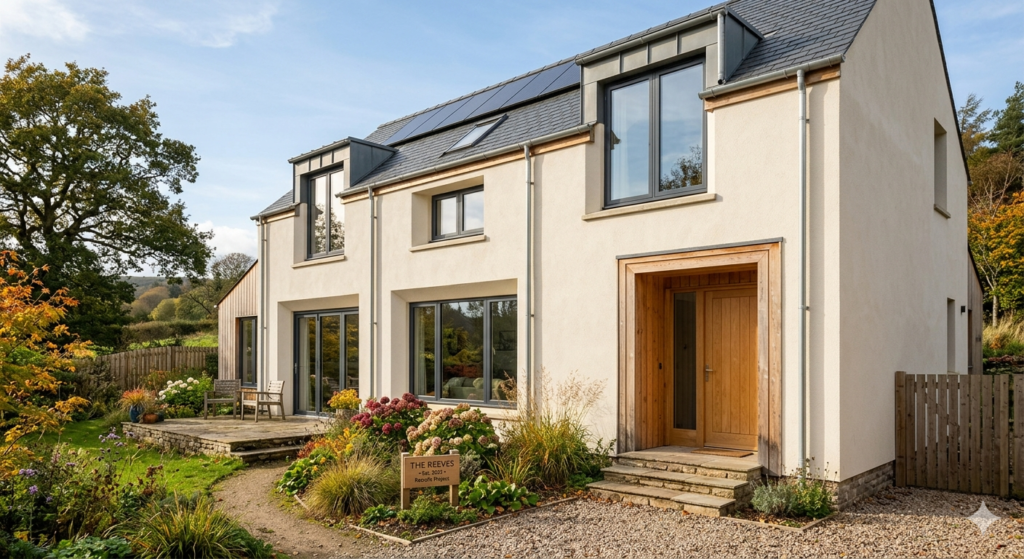
What is the EnerPHit standard? The EnerPHit standard is a rigorous energy performance certification created specifically for retrofitting existing buildings. Developed by the Passive House Institute, it requires high-quality thermal insulation, stringent airtightness, and mechanical ventilation with heat recovery, resulting in dramatic energy savings and exceptional indoor comfort.
In standard building codes, regulations dictate how you must build (e.g., specifying a certain thickness of insulation). EnerPHit dictates how the building must perform. It is a performance-based target. You are free to choose the materials and methods, provided the final home meets strict scientific metrics for heating demand, cooling demand, and primary energy usage.
By meeting these metrics, an older, drafty property can be transformed to perform almost as efficiently as a brand-new, cutting-edge eco-home, drastically reducing heating bills by up to 90%.
Why Not Aim for Full Passive House?
A common question during the planning phase is why a retrofit cannot simply meet the standard “Classic” Passive House criteria. The answer lies in the unchangeable “bones” of an existing structure.
To become a classic certified passive house, a building must have a maximum space heating demand of 15 kWh per square meter per year. However, older homes have built-in “thermal bridges” that cannot be easily fixed. For example, a solid concrete basement foundation extending into the frozen earth acts as a massive thermal leak. Digging up and lifting an entire house to insulate beneath its existing footings is incredibly risky and expensive.
The EnerPHit standard acknowledges these structural realities. It slightly relaxes the heating demand requirement (allowing roughly 25 kWh per square meter per year, depending on the climate zone). This provides a realistic, achievable target for renovations without compromising on the quality of the building components used.
Key Criteria: Air Changes Per Hour Retrofit
One of the most challenging aspects of any retrofit is stopping drafts. Airtightness is a non-negotiable pillar of the Passive House philosophy. Without it, insulation cannot function properly, and heat recovery ventilation (MVHR) becomes highly inefficient.
In new Passive House construction, the building must score a 0.6 ACH50 (Air Changes per Hour at 50 Pascals of pressure) on a blower door test. Because sealing the complex junctions of an old timber roof to a masonry wall is notoriously difficult, the air changes per hour retrofit target under EnerPHit is relaxed to 1.0 ACH50.
While 1.0 ACH50 is slightly more lenient than a new build, it is still incredibly strict compared to standard housing. A typical older home might score between 10.0 and 15.0 ACH50. Reaching 1.0 requires meticulous detailing, specialized airtight tapes, and vapor control membranes applied seamlessly across the entire building envelope.
The Role of PHPP Modeling
Achieving these exacting standards requires intense mathematical precision. You cannot simply guess how thick your insulation needs to be. During the planning stage, architects and energy assessors rely heavily on PHPP modeling.
Using specialized PHPP (Passive House Planning Package), building physicists input every detail of your home. They enter the local climate data, the specific U-values of your chosen windows, the shading from nearby trees, and the length of your hot water pipes. The software accurately predicts exactly how much energy your house will use before construction even begins.
This modeling is the heartbeat of a successful Retrofit Roadmap. It allows you to run “what-if” scenarios. If upgrading to triple-glazing is too expensive, the software can show you if adding two extra inches of roof insulation will compensate for the heat loss, keeping you on track for certification while managing your budget.
Certification by the Passive House Institute
The final step in the journey is official verification. The Passive House Institute, founded in Germany, is the independent governing body that oversees the EnerPHit standard globally.
Certification is an intense quality assurance process. Your architect or designer must submit all their PHPP calculations, detailed architectural drawings, and photographic evidence of the construction details (like airtight tape applied to window frames) to an independent certifier. They must also submit the final, passing blower door test results and commissioning reports for the ventilation system.
If the numbers align, the building is officially certified. This plaque on the wall guarantees that the home will perform exactly as designed, providing unparalleled indoor air quality, thermal comfort, and resilience against rising energy costs for decades to come.
Conclusion
Aiming for the EnerPHit standard is not for the faint of heart; it requires a commitment to building physics, meticulous craftsmanship, and rigorous PHPP modeling. However, the reward is the absolute pinnacle of residential performance. By working within the guidelines set by the Passive House Institute, homeowners can transform aging, inefficient structures into a certified passive house retrofit. Meeting the strict air changes per hour retrofit targets and upgrading the thermal envelope guarantees a home that is supremely comfortable, phenomenally cheap to run, and truly prepared for a zero-carbon future.
Frequently Asked Questions (FAQ)
1. Can any old house achieve the EnerPHit standard?
While almost any house can be massively improved, achieving the exact EnerPHit certification can be physically impossible or prohibitively expensive for some highly complex or severely degraded historic homes. Buildings with strict heritage preservation rules (where external insulation and window replacement are banned) often struggle to meet the criteria.
2. What is an EnerPHit Step-by-Step Retrofit Plan?
Recognizing that deep retrofits are expensive, the Passive House Institute allows for an “EnerPHit Retrofit Plan” (ERP). This allows a homeowner to phase the work over many years (e.g., windows in year one, roof in year three). The PHPP software models the entire final project to ensure that the early steps do not cause “lock-in” or prevent the home from achieving full certification at the end of the roadmap.
3. Is PHPP modeling really necessary, or can I just use standard building codes?
If you want to achieve EnerPHit certification, PHPP modeling is strictly required. Standard building codes use simplified assumptions that are not accurate enough for ultra-low energy design. PHPP accounts for highly complex variables like solar heat gain, internal heat loads (from appliances and people), and specific thermal bridging.
4. How much more does an EnerPHit retrofit cost compared to a standard renovation?
It typically costs 10% to 20% more than a high-quality standard renovation. The extra costs come from thicker insulation, high-performance triple-glazed windows, a dedicated MVHR system, and the consulting fees for energy modeling and certification. However, the operational heating costs are drastically slashed, offering a long-term financial payback.